A zero-based budget is a monthly plan where your income minus everything you assign equals exactly zero. That doesn't mean you spend everything. It means every dollar has a job before the month begins, whether that job is rent, groceries, savings, extra debt payments or a weekend trip.
If a regular budget is a map, a zero-based budget is turn-by-turn directions. It takes a little more effort up front, and many people find it's the method that finally makes their money feel under control.
New to budgeting entirely? Start with Budgeting for Beginners and come back here after a month or two.
How zero-based budgeting works
The formula is simple:
Income − (bills + spending + savings + debt payments) = $0
If you have money "left over," you haven't finished the budget yet. You assign it somewhere: an emergency fund, a sinking fund, a debt or next month's buffer. If you've assigned more than you earn, you trim categories until the math balances.
The point isn't the zero. The point is the decisions. When every dollar is assigned on purpose, you notice tradeoffs. Choosing to spend $150 on dining out is a choice not to put that $150 toward a goal, and seeing that in writing tends to change behavior.
What you'll need
- Your expected take-home income for the month (from pay stubs or bank deposits)
- A list of recurring bills with amounts and due dates
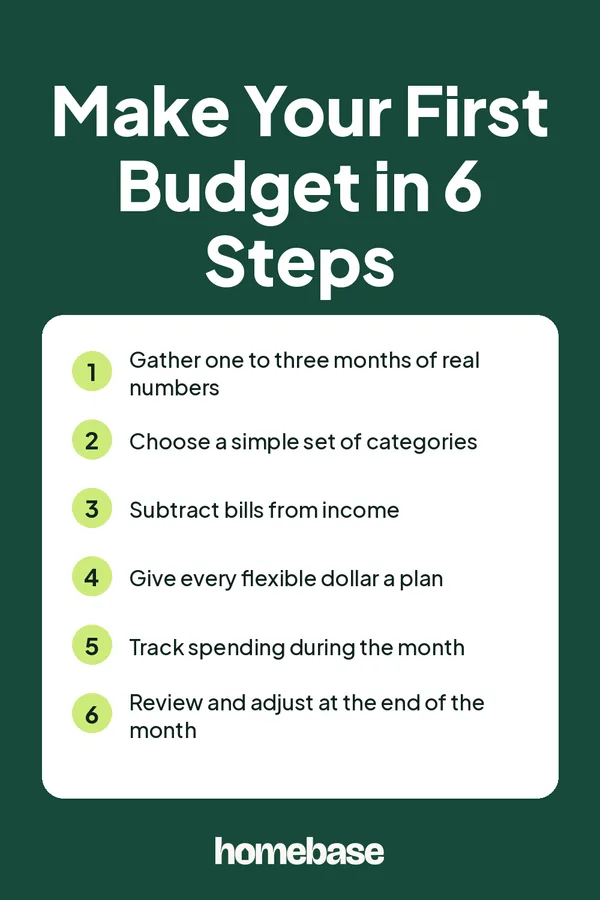
- Your last one to three months of spending, roughly categorized
- A tool: paper, a spreadsheet, or an app
A bill list is especially useful because it shows which paycheck needs to cover which bill. If you don't have one, our Bill Tracker Spreadsheet is a quick way to build it.
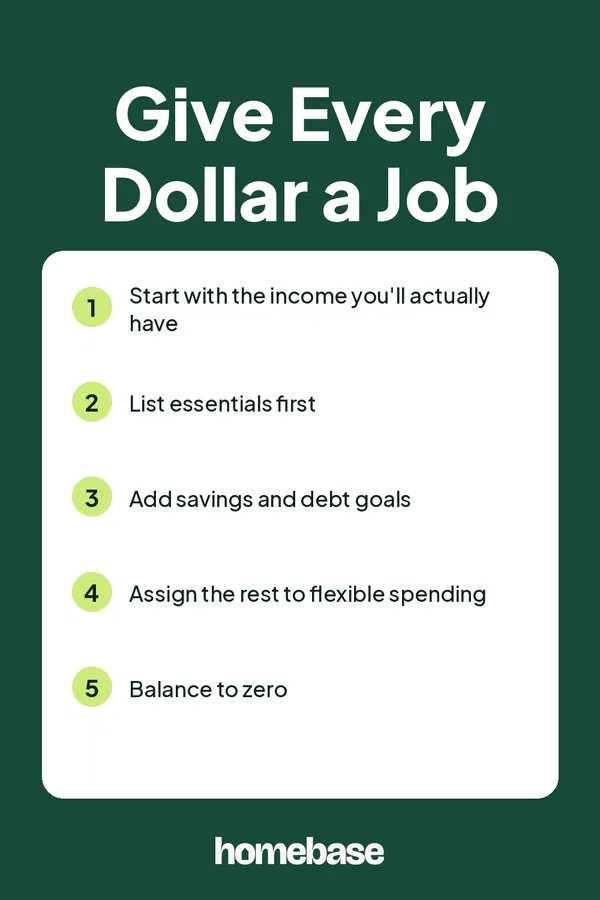
Step 1: Start with the income you'll actually have
Write down the take-home pay you expect this month. If your income varies (hourly work, commission, self-employment), use a conservative number, such as your lowest month from the past several months. If you earn more, you assign the extra when it arrives. Budgeting on a low baseline is much less stressful than budgeting on hope.
Step 2: List essentials first
Assign money in priority order. The CFPB's debt and budgeting resources suggest covering basic needs first: housing, utilities, food, transportation to work and minimum debt payments. Write those down before anything else.
Step 3: Add savings and debt goals
Next, assign money to the things that move you forward:
- Emergency fund contributions, even a small amount
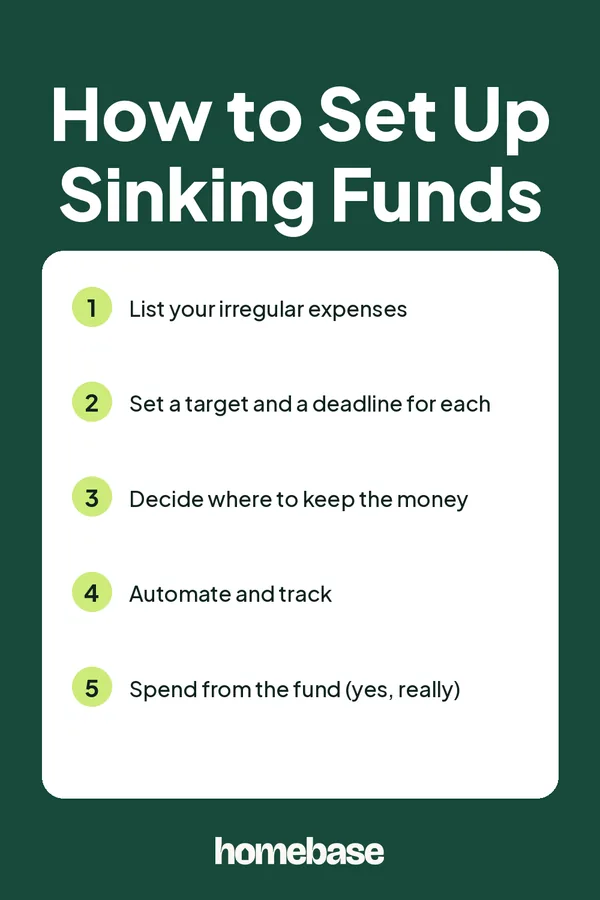
- Sinking funds for predictable irregular costs (car registration, holidays, annual insurance). See our sinking funds guide.
- Extra debt payments above the minimums, if paying off debt is a goal. Our snowball vs. avalanche guide helps you pick a target.
Putting savings before flexible spending is the key move. If savings come last, they're usually the first thing to disappear.
Step 4: Assign the rest to flexible spending
Now fill in groceries, gas, household items, kids' activities, personal spending, dining out, gifts and so on. Use your past spending as a reality check.
Step 5: Balance to zero
Add up every category and subtract from income. Three outcomes:
- Exactly $0: done.
- Money left over: assign it. Bump a savings goal, add to a debt payment, or create a small "buffer" category for the unexpected.
- Negative: trim. Start with the most flexible categories (dining out, entertainment, shopping) and work toward the essentials only if you must.
A worked example
Here's a simplified example for a household with $5,000 in monthly take-home pay. These are illustrative numbers, not recommendations; your amounts will differ.
| Category | Planned | Left to assign |
|---|---|---|
| Income | $5,000 | |
| Rent | $1,650 | $3,350 |
| Utilities + internet + phone | $380 | $2,970 |
| Car payment + insurance | $520 | $2,450 |
| Minimum debt payments | $210 | $2,240 |
| Groceries + household | $800 | $1,440 |
| Gas | $220 | $1,220 |
| Childcare / kids | $300 | $920 |
| Emergency fund | $200 | $720 |
| Sinking funds (car, gifts, annual bills) | $250 | $470 |
| Extra debt payment | $200 | $270 |
| Dining out | $120 | $150 |
| Personal spending (two adults) | $100 | $50 |
| Buffer | $50 | $0 |
Notice the "Left to assign" column. Watching it shrink to zero is what makes this method click for many people. Our Zero-Based Budget Spreadsheet calculates that column for you and turns it green when you hit zero.
Zero-based budgeting by paycheck
If you're paid weekly or every two weeks, doing one monthly budget can be confusing because bills don't line up neatly with paydays. A paycheck-based version fixes that:
- List each paycheck date for the month.
- Assign bills to the paycheck that arrives before each due date.
- Split flexible categories (like groceries) across paychecks.
- Make each paycheck balance to zero on its own.
Biweekly earners get two "three-paycheck months" in most years. Decide in advance what those extra checks will do, such as a sinking fund or a debt, so they don't get absorbed into everyday spending. The Paycheck Budget Spreadsheet is laid out paycheck by paycheck for this reason.
During the month: track and adjust
A zero-based budget is a plan, not a prediction. Things will change. When you overspend in one category, move money from another category so the budget still balances. This is the rule that keeps the system honest: you can change the plan any time, but the total still has to equal your income.
Practical tracking tips:
- Record transactions two or three times a week so it never piles up.
- Keep a short list of "quick-move" categories (dining out, personal, buffer) that you'll pull from first when something comes up.
- If you use cash envelopes, refill them only on paydays, using the budgeted amount.
Common problems and how to solve them
"I always run out before the end of the month." Look at timing, not just totals. You may have enough money monthly but not enough before a specific bill. Switch to the paycheck method above, or slowly build a one-month buffer so you're spending last month's income.
"My income is irregular." Budget your baseline income. When extra income comes in, assign it in a fixed priority order you choose in advance (for example: buffer, then emergency fund, then debt, then fun).
"It takes forever." The first month takes the longest. After that, you're copying last month's plan and adjusting a few numbers. Many people get it down to 20 to 30 minutes.
"My partner isn't on board." Start with shared goals ("we want to stop stressing about the car insurance bill") rather than restrictions. Give each person a personal spending category that's theirs to use freely.
"I forget irregular expenses." Make a list of everything that came up last year and wasn't monthly, then add those as sinking fund categories.
Zero-based budget vs. other methods
- 50/30/20 splits income into broad buckets. It's easier but less precise; zero-based gives you control at the category level.
- Cash envelope system is often used inside a zero-based budget for categories that are hard to control.
- "Pay yourself first" sets savings aside automatically and lets you spend the rest freely. It's lower effort; zero-based is more detailed.
There's no single right method. The best budget is the one you'll keep doing.
Quick-start checklist
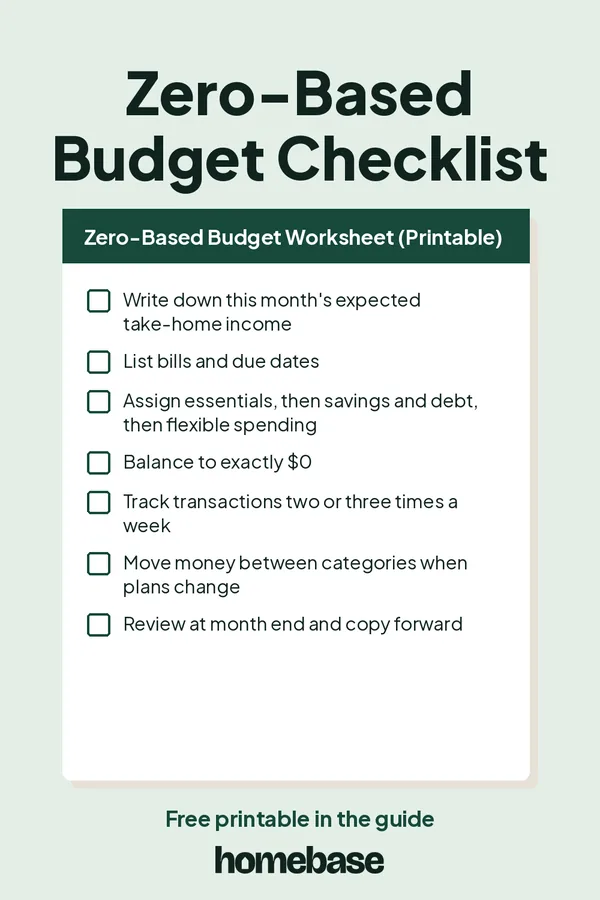
- Write down this month's expected take-home income
- List bills and due dates
- Assign essentials, then savings and debt, then flexible spending
- Balance to exactly $0
- Track transactions two or three times a week
- Move money between categories when plans change
- Review at month end and copy forward
This guide is general education and not personalized financial advice.
From our shop
Tools from our shop that go with this guide
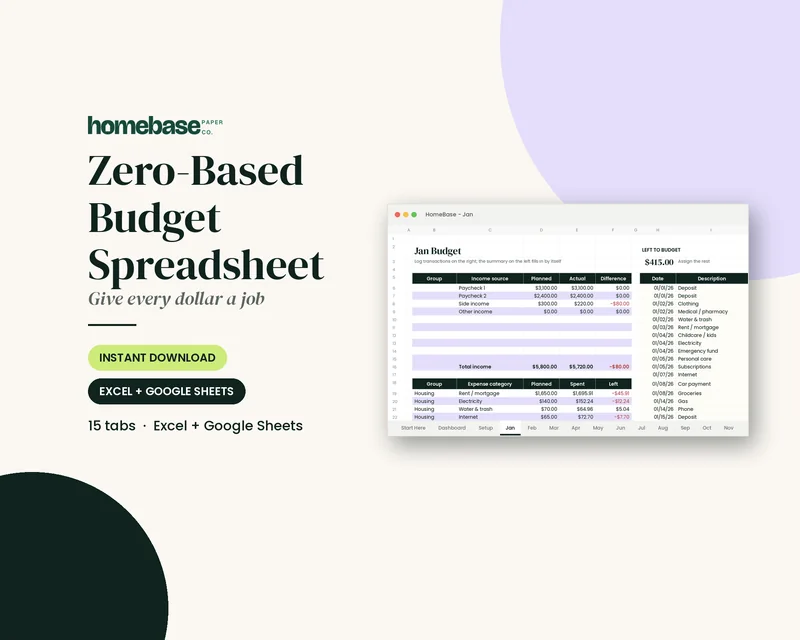
Spreadsheet (Excel + Google Sheets)
Zero-Based Budget Spreadsheet
The 'Left to budget' counter turns green when every dollar has a job.
View on Etsy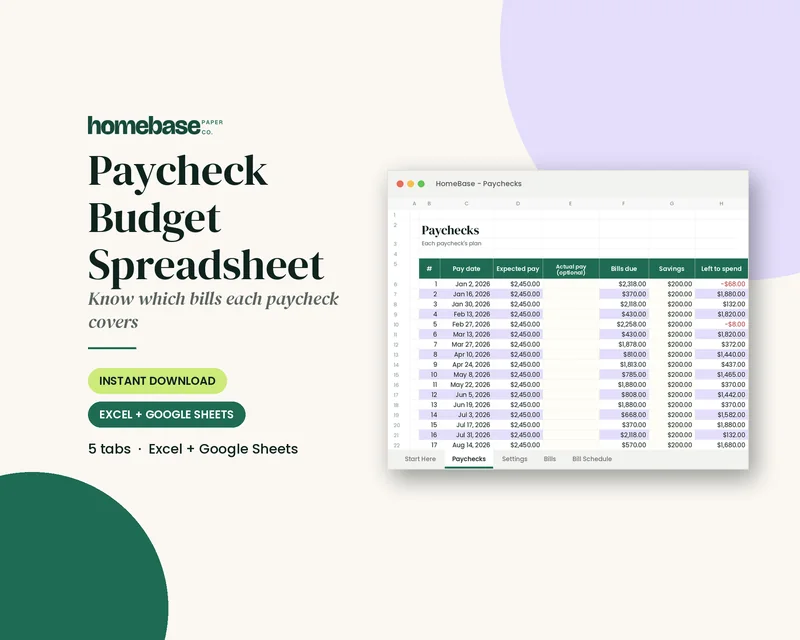
Spreadsheet (Excel + Google Sheets)
Paycheck Budget Spreadsheet
Enter your bills once. The sheet tells you which paycheck pays each one, all year.
View on Etsy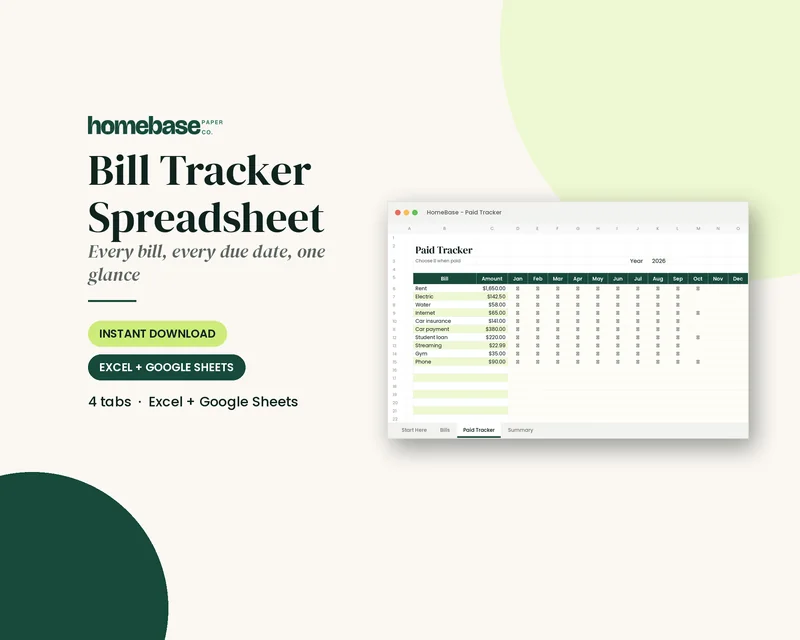
Spreadsheet (Excel + Google Sheets)
Bill Tracker Spreadsheet
Bills due in 3 days or less light up red, so nothing slips through.
View on EtsySave this guide for later