A household binder (sometimes called a home management binder or family command center) is a single place where the important information that runs your home lives. Instead of searching through emails, texts, sticky notes and your memory, you open one binder.
It's especially helpful when more than one person runs the house, when a babysitter or relative steps in, or when life gets busy and things start falling through the cracks.
Why use a physical binder?
Digital tools are great, and you can absolutely keep a digital version. But a physical binder has advantages:
- Anyone can use it, including grandparents, sitters and kids, without logins.
- It works when the power or internet doesn't.
- It's visible. A binder on the counter is a reminder; an app is easy to forget.
Many families use both: a binder for the core reference pages and a shared digital calendar for day-to-day scheduling.
What you'll need
- A 2-inch three-ring binder with clear view cover (choose a size that leaves room to grow)
- tabbed binder dividers
- A few clear sheet protectors for pages you'll reference often or write on with dry-erase markers
- A zippered pouch for pens, stamps, and small items
- Printable pages (or our Household Binder, which includes all of the sections below)
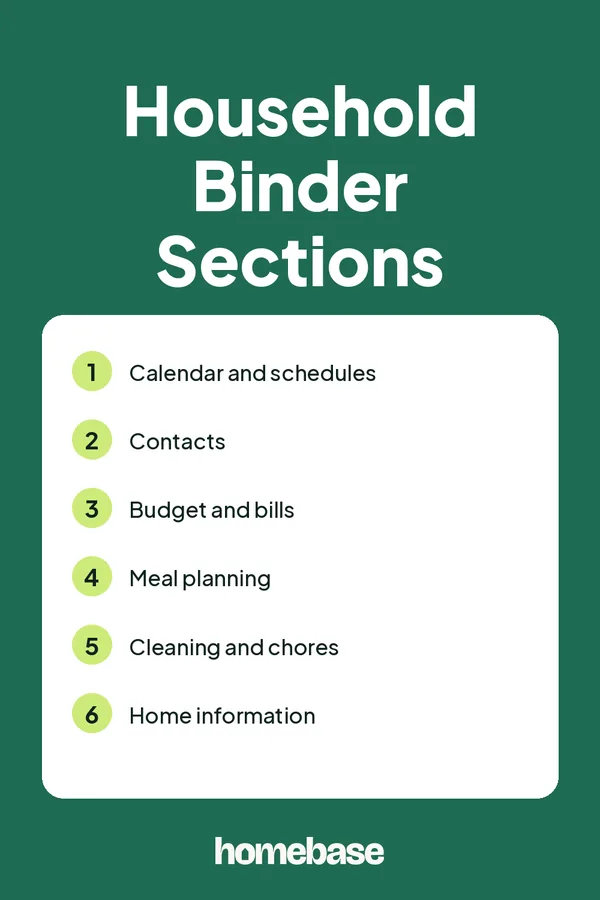
Section 1: Calendar and schedules
- Monthly calendar pages for the year
- A weekly family schedule (school, work, activities)
- A school year calendar
- Important dates: birthdays, anniversaries, renewals
Section 2: Contacts
- Emergency contacts
- Family, neighbors and friends
- Doctors, dentists, pharmacies, vets
- Schools, teachers, coaches and childcare
- Service providers: plumber, electrician, HVAC, lawn care
Section 3: Budget and bills
- Monthly budget pages
- A bill list with due dates and how each is paid
- Savings goals and sinking fund trackers
- Debt payoff tracker, if applicable
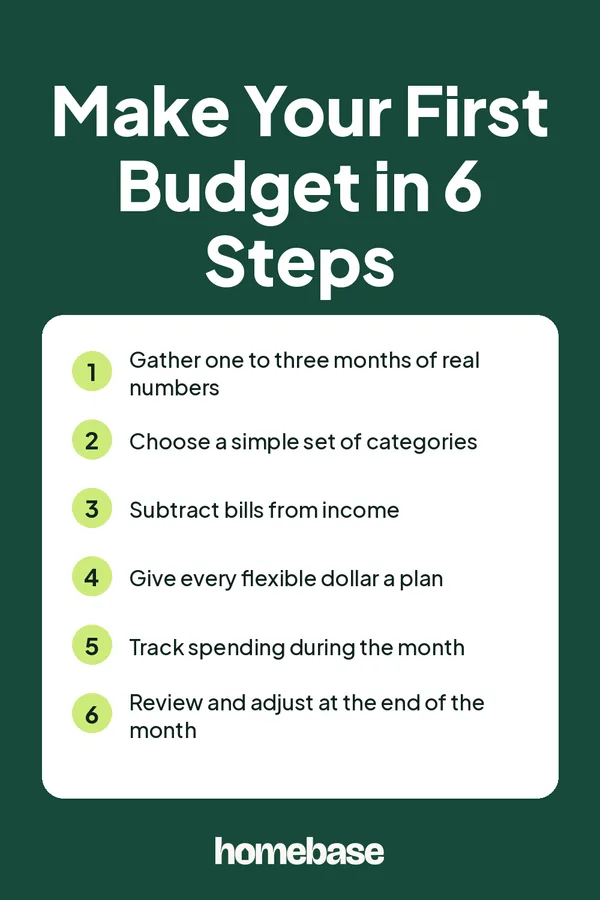
If you're new to budgeting, our Budgeting for Beginners guide helps you fill these in.
Section 4: Meal planning
- Weekly meal plan templates
- Grocery list template organized by store section
- A list of family-favorite meals (when you can't think of anything, start here)
- Recipe pages or cards
See our guide to meal planning on a budget.
Section 5: Cleaning and chores
- Daily, weekly and monthly cleaning checklists
- A seasonal deep-cleaning list
- Kids' chore charts. Our chore chart by age guide has ideas.
Our Cleaning Schedule printable fits right into this section.
Section 6: Home information
- Paint colors and finishes for each room
- Appliance list with model and serial numbers
- Warranty information and purchase dates
- Home maintenance checklist and log. See our seasonal maintenance checklist.
- Location of the water shutoff, electrical panel and gas shutoff
- Wi-Fi network name (consider keeping the password elsewhere)
Section 7: Kids and school
- School information and schedules
- Activity schedules and fees
- Medical info and allergies for each child
- Babysitter information sheet: house rules, bedtimes, emergency info
Section 8: Pets
- Vet contact information
- Vaccination records
- Feeding instructions and medications
- Pet sitter instructions
Section 9: Health
- A summary page for each family member: allergies, medications, conditions, doctors, insurance info
- Appointment log
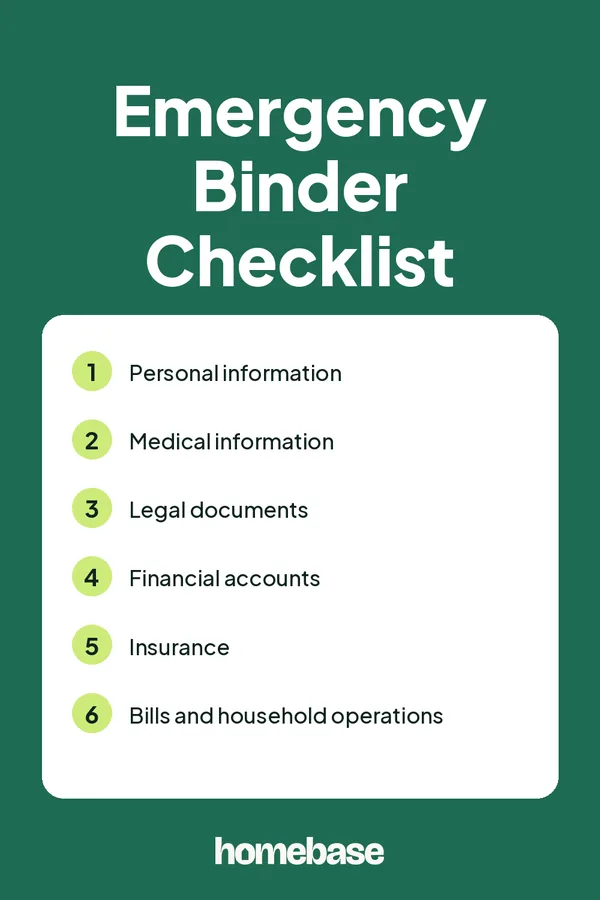
Section 10: Emergency information
- Your family emergency plan (meeting places, out-of-area contact). Ready.gov has a straightforward guide to making a family emergency plan.
- Emergency supply kit checklist. See Ready.gov's kit list.
- Insurance policy numbers and claims phone numbers
- Location of important documents
A word about sensitive information
A household binder is meant to be easy to grab, which also means it's easy for others to see. Be thoughtful about what goes in it:
- Don't keep full Social Security numbers, full account numbers, or passwords in a binder that sits on the counter.
- Do note where sensitive documents are kept (a safe, a lockbox, a password manager).
- If you keep a written password log, store it separately and securely. Our Password & Accounts Log is designed to be kept in a secure place, not on the kitchen counter.
For detailed financial and legal information that someone might need in a crisis, consider a separate, secured "if something happens to me" binder. We cover that in what to put in an if something happens to me binder.
How to set it up in one afternoon
- Pick your sections. Start with four or five that you'll actually use. Calendar, Contacts, Budget, Meals and Emergency is a great core set.
- Print pages for those sections only.
- Fill in the reference pages first: contacts, emergency info, home info. These are "set it once" pages.
- Put the binder somewhere visible: the kitchen counter, a shelf by the door, or a "command center" wall.
- Add sections gradually as you find a need.
Printing tips
- Print reference pages on regular paper, and pages you'll write on every week on slightly heavier paper so they hold up.
- If you print at home, set your printer to "fit to page" for PDFs so nothing gets cut off at the margins.
- Print one month of calendar and budget pages at a time, so the binder doesn't fill up with blank pages you may never use.
- Keep a few spare copies of the pages you use most (meal plans, grocery lists) in the back pocket of the binder.
How to keep it up to date
A binder is only useful if it's current. Try this rhythm:
- Weekly (10 minutes): update the meal plan, check the calendar, add new appointments.
- Monthly (20 minutes): start the new budget page, review bills, update chore charts.
- Every six months (30 minutes): review contacts, medical info and emergency details. A good reminder is when you change your clocks or test your smoke alarms.
Ideas to make it work for your family
- Color-code by person so everyone can find their information quickly.
- Use dry-erase sheet protectors for chore charts and weekly menus you reuse.
- Keep a "babysitter page" at the very front with the most important info on one sheet.
- Make it pretty if that motivates you. A cover you love makes the binder more inviting to open.
Household binder vs. home management bundle
If you want to expand beyond the basics, our Home Management Bundle combines the household binder with a home maintenance log, cleaning schedule and home inventory, so the whole house is covered.
Frequently asked questions
Is a household binder the same as an emergency binder? Not quite. A household binder is for everyday life: schedules, meals, chores and home information. An emergency or "if something happens to me" binder holds sensitive financial and legal details and should be stored securely. Many families keep both, with the household binder noting where the secure one is kept.
How big should my binder be? Start with a 1.5- or 2-inch binder. If it gets too full, split it into two: one for daily planning (calendar, meals, chores) and one for reference (home info, health, emergency).
Should I go digital instead? Use whatever your household will actually keep up with. A good compromise is a physical binder for reference pages that rarely change, and a shared digital calendar for schedules that change every week.
What's the first page I should make? An emergency contact and information sheet. It's the page a babysitter, relative or neighbor is most likely to need, and it's useful on day one even if nothing else is finished.
How do I get my family to use it? Keep it in the same visible spot every day, and make it the place where answers live. When someone asks "what's for dinner?" or "when is practice?", point them to the binder. After a few weeks, it becomes a habit.
Quick-start checklist
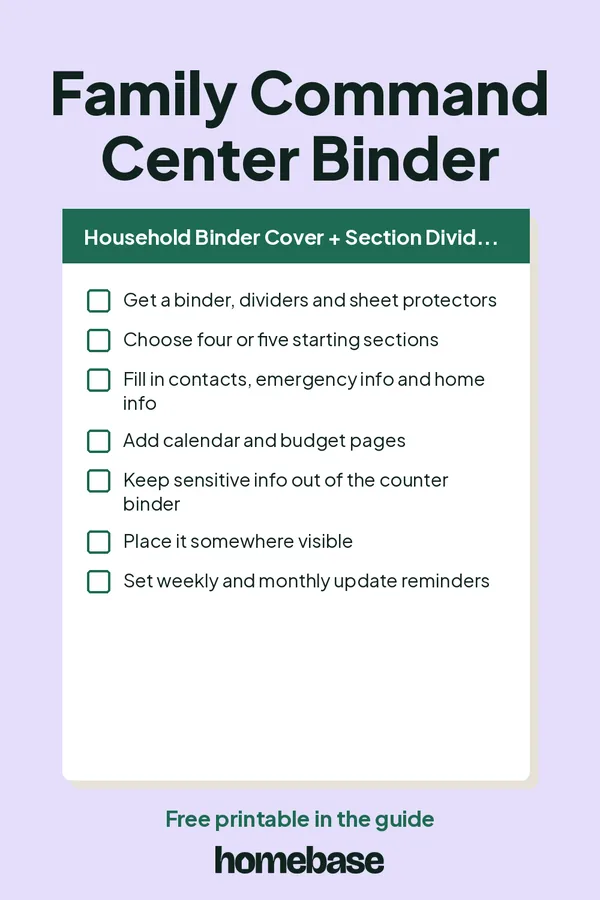
- Get a binder, dividers and sheet protectors
- Choose four or five starting sections
- Fill in contacts, emergency info and home info
- Add calendar and budget pages
- Keep sensitive info out of the counter binder
- Place it somewhere visible
- Set weekly and monthly update reminders
From our shop
Tools from our shop that go with this guide
Printable PDF
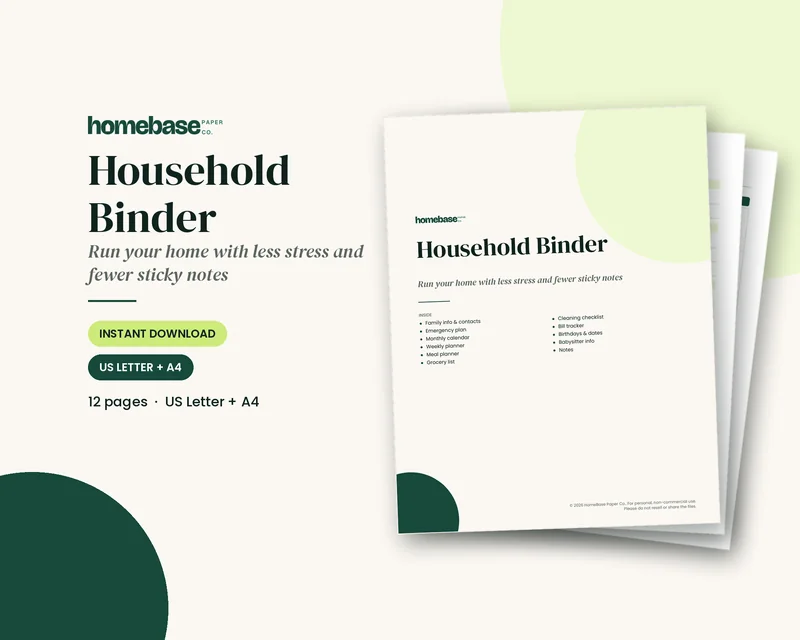
Household Binder
Family info, emergency plan, calendars, meals, groceries, cleaning, bills and sitter notes.
View on Etsy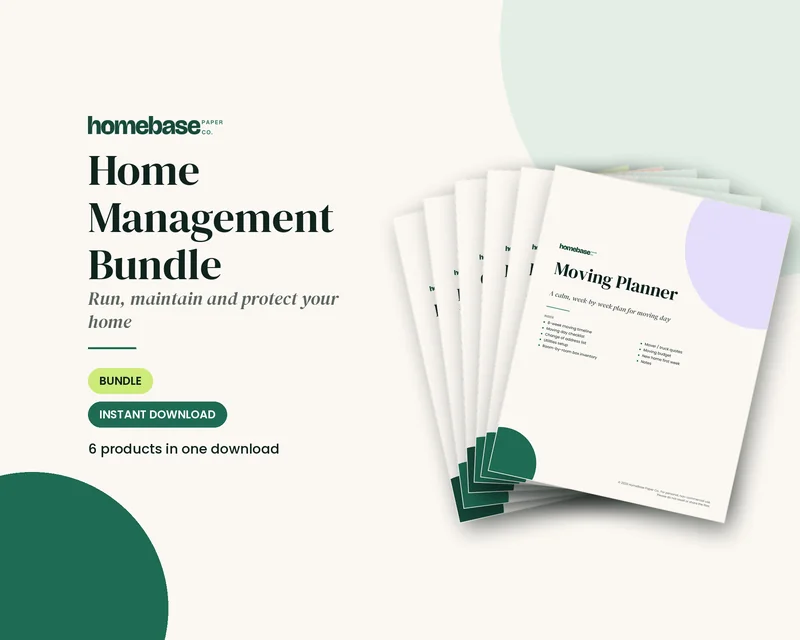
Bundle
Home Management Bundle
Household binder, maintenance log, moving planner, cleaning schedule, home inventory and password log.
View on Etsy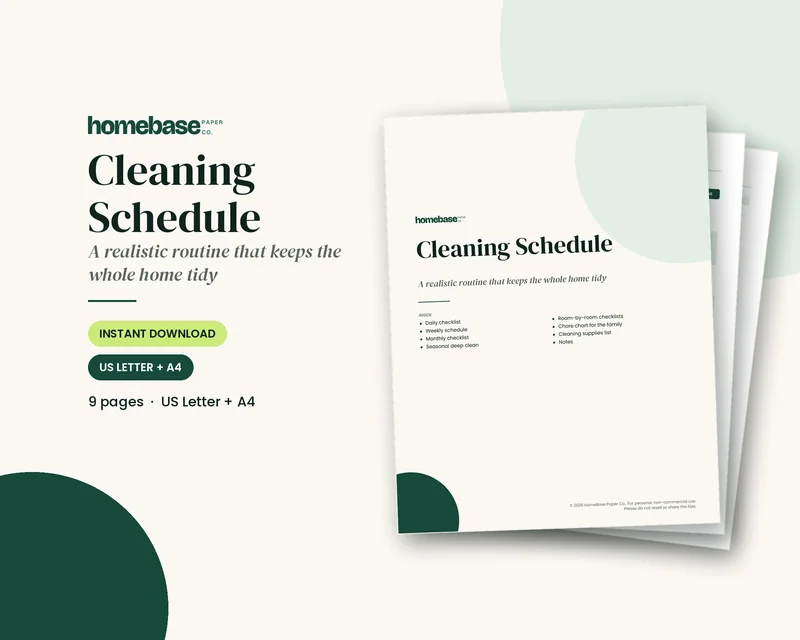
Printable PDF
Cleaning Schedule
Daily, weekly, monthly and seasonal lists - plus a family chore chart.
View on Etsy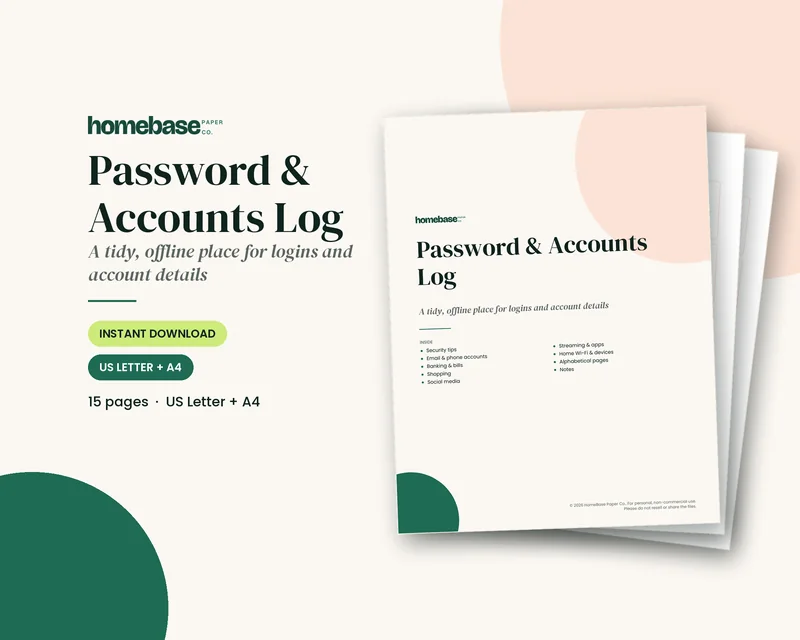
Printable PDF
Password & Accounts Log
Organized by category and A-Z, with room for hints instead of full passwords.
View on EtsySave this guide for later