A home inventory list for insurance records what you own, room by room, with enough detail to prove value after a fire, flood or theft: item, brand and model, purchase date, cost, serial number and a photo. Doing it now, while everything is in place, is far easier than trying to remember a whole house after a loss.
Here's what to record, an example page, and printable options that make it quick.
Why an inventory matters
After a major loss, insurers generally ask you to list what was damaged or stolen and support its value. Without a list, people tend to forget a large share of what they owned: the contents of closets, the garage, kitchen drawers. A written inventory, backed by photos and receipts, makes the claim faster and more complete. It also helps you check whether your coverage limits are high enough.
What to record for each item
| Field | Example |
|---|---|
| Room | Living room |
| Item | Television |
| Brand and model | Samsung, model number from the back label |
| Serial number | From the label or settings menu |
| Quantity | 1 |
| Purchase date | Nov 2024 |
| Purchase price | $649 |
| Photo taken? | ✓ |
| Receipt location | Email folder "Receipts 2024" |
For furniture and everyday items, room, item, quantity and an approximate value are usually enough. Save the full detail for electronics, appliances, jewelry, tools, instruments and collectibles.
A sample room page
| Item | Qty | Brand / model | Year | Cost | Photo |
|---|---|---|---|---|---|
| Sofa | 1 | West Elm sectional | 2022 | $1,800 | ✓ |
| Television | 1 | Samsung 65" | 2024 | $649 | ✓ |
| Sound bar | 1 | Sonos | 2023 | $449 | ✓ |
| Rug | 1 | 8 x 10 wool | 2021 | $420 | ✓ |
| Lamps | 2 | Target | 2022 | $90 | ✓ |
| Room total | $3,408 |
A page total for each room makes it easy to see your whole home's contents value, which is the number to compare with your policy's personal property limit.
Our inventory options
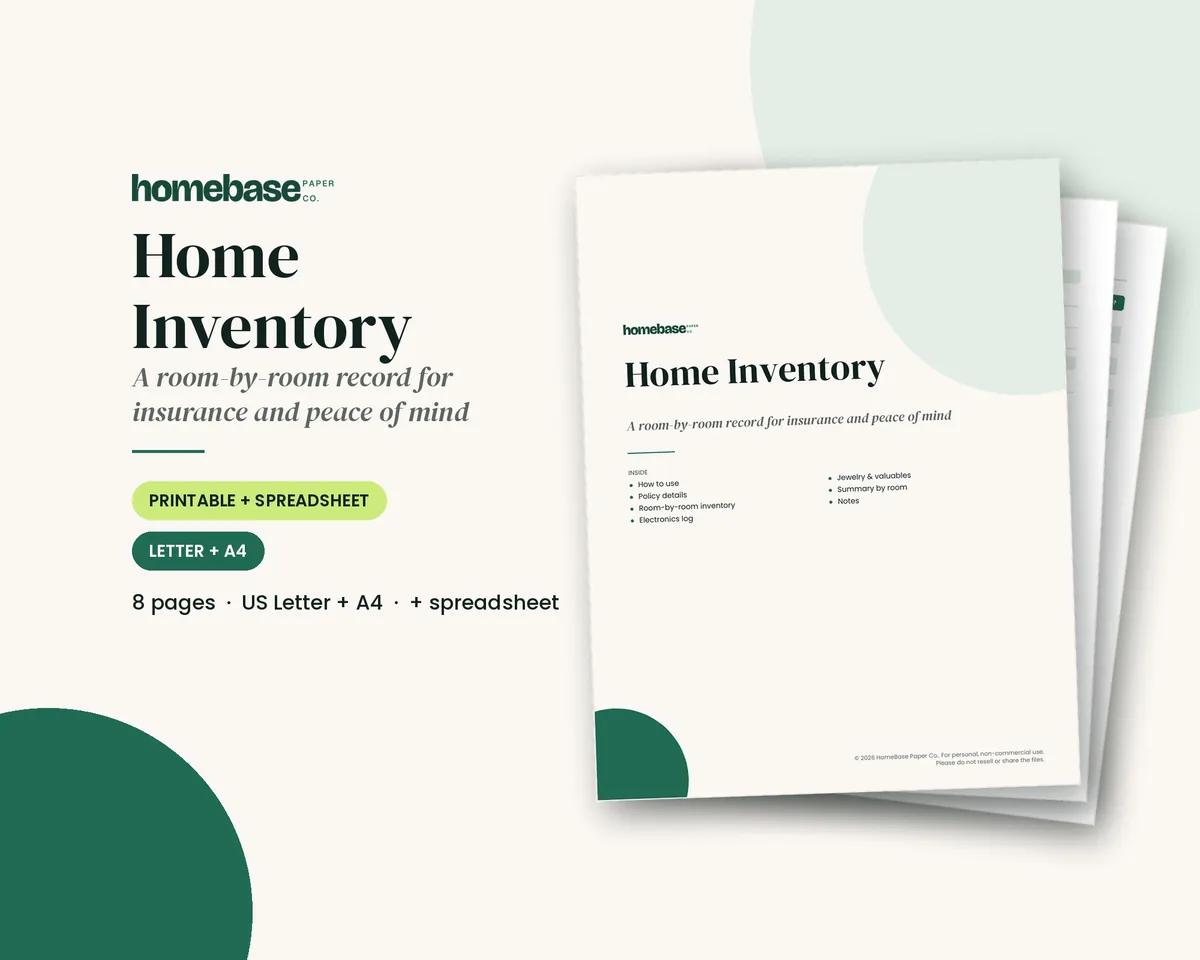
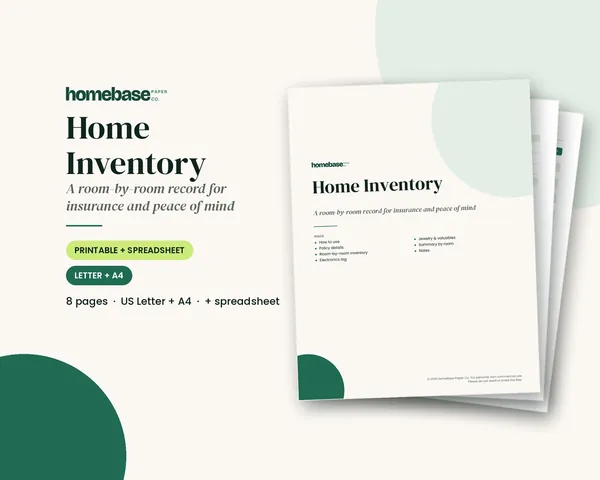
The Home Inventory printable + spreadsheet ($5.49) includes how-to pages, a policy details page, room inventory pages, electronics, jewelry and valuables pages, a summary by room and notes, in US Letter and A4. The included spreadsheet for Excel and Google Sheets totals the value of every room automatically.
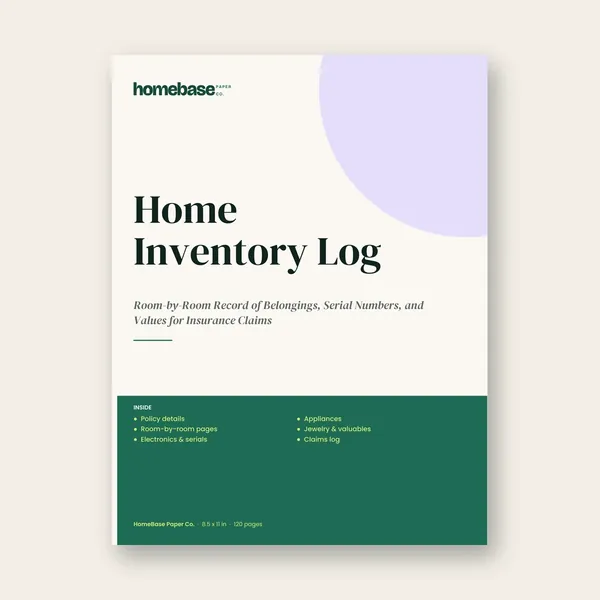
Prefer a bound book? The Home Inventory Log (paperback, $10.99) is an 8.5 x 11 inch, 120-page book with policy details, 84 room inventory pages and special logs for electronics and serial numbers, appliances, jewelry and valuables, and art and heirlooms. It's printed and shipped by Amazon.
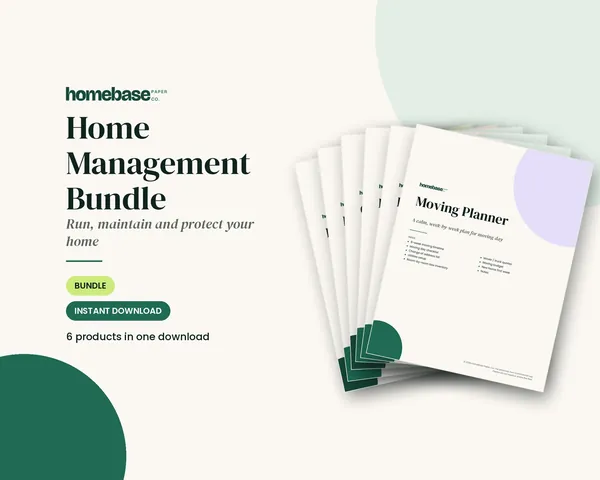
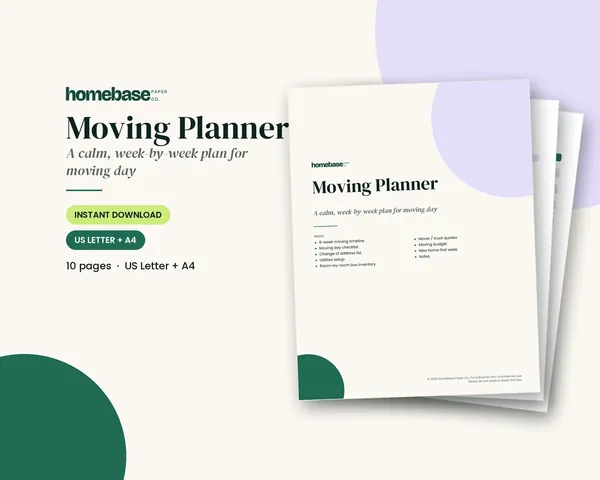
Both pair well with the Moving Planner if you're about to move; an inventory doubles as a packing and moving-claim record. The Home Inventory is also included in the Home Management Bundle ($16.99).
How to do a whole-house inventory in a weekend
- Fill in the policy page first: insurer, policy number, agent, deductible and coverage limits.
- Walk each room with your phone and record a slow video, opening closets and drawers and narrating brand names.
- Photograph labels on electronics and appliances for model and serial numbers.
- Fill in the room pages from the video, starting with high-value items.
- Gather receipts from email searches and store accounts. Note where each one lives.
- Total each room, then the house. Compare with your policy limit.
- Store copies away from home: a cloud folder plus a printed copy with a relative or in a safe deposit box.
Renters need an inventory too
Renters insurance covers your belongings, not the building, so an inventory matters just as much in an apartment. It is also quicker: most apartments can be done in an afternoon. Pay extra attention to electronics, bikes, instruments and anything stored in a shared basement or storage unit, because those are common in theft claims. When you move out, the same pages help you check that nothing went missing in the move.
Keeping it current
Add big purchases the day they arrive, including holiday gifts. Once a year, ideally when your policy renews, walk the house for 30 minutes and update each room. Record what you've sold or donated, too.
Mistakes to avoid
- Keeping the only copy in the house. If the house is damaged, so is the list.
- Skipping the garage, attic and basement, where tools, sports gear and seasonal items add up quickly.
- Rounding everything. Record actual prices where you can find them.
- Forgetting clothing. Estimate by category, such as "12 work shirts, about $30 each."
Check with your insurance agent about what documentation your specific policy requires.
Frequently asked questions
What should a home inventory for insurance include?
Record each room's items with a description, brand and model, serial number for electronics and appliances, quantity, purchase date and price, plus photos and where the receipt is saved. Add your policy details and keep copies stored outside the home so they survive a fire or flood.
How long does a home inventory take?
A typical home can be done over a weekend if you record a video of each room first and fill in the pages from it. Start with high-value items like electronics, jewelry and appliances, then add furniture and everyday items room by room at your own pace.
Is a spreadsheet or a printed inventory better?
A spreadsheet totals values automatically and is easy to back up to the cloud. A printed or bound inventory is easy to hand to an adjuster and doesn't depend on a device. Our Home Inventory includes both printable pages and a spreadsheet so you can keep one of each.
How often should I update my home inventory?
Add major purchases as soon as you make them and do a quick full review once a year, ideally at policy renewal. Updating after holidays, birthdays or a move is also a good habit, since that's when the most new items come into the home.
Free download
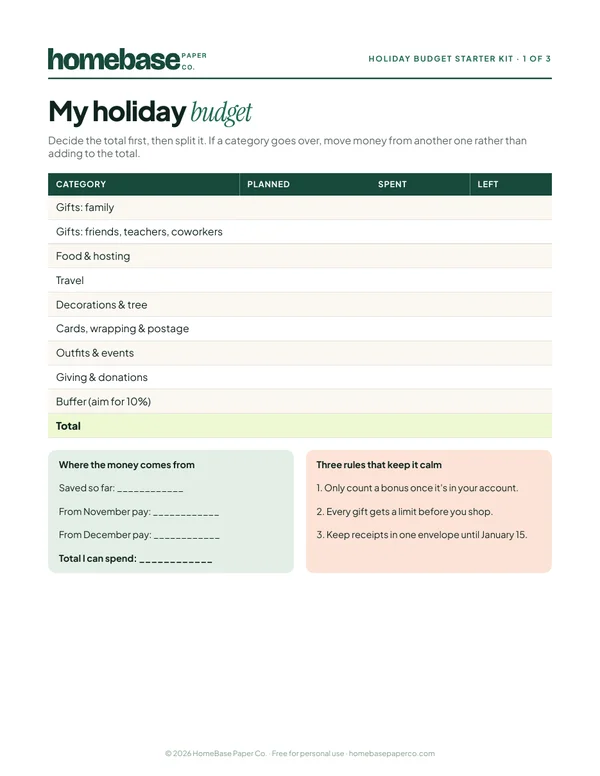
The Holiday Budget Starter Kit
A one-page holiday budget, a gift list with a spending limit for every person, and a 6-week countdown so December stays calm and paid for.
Free, no sign-up needed.